Rendering glass, ice and condensation in CGI
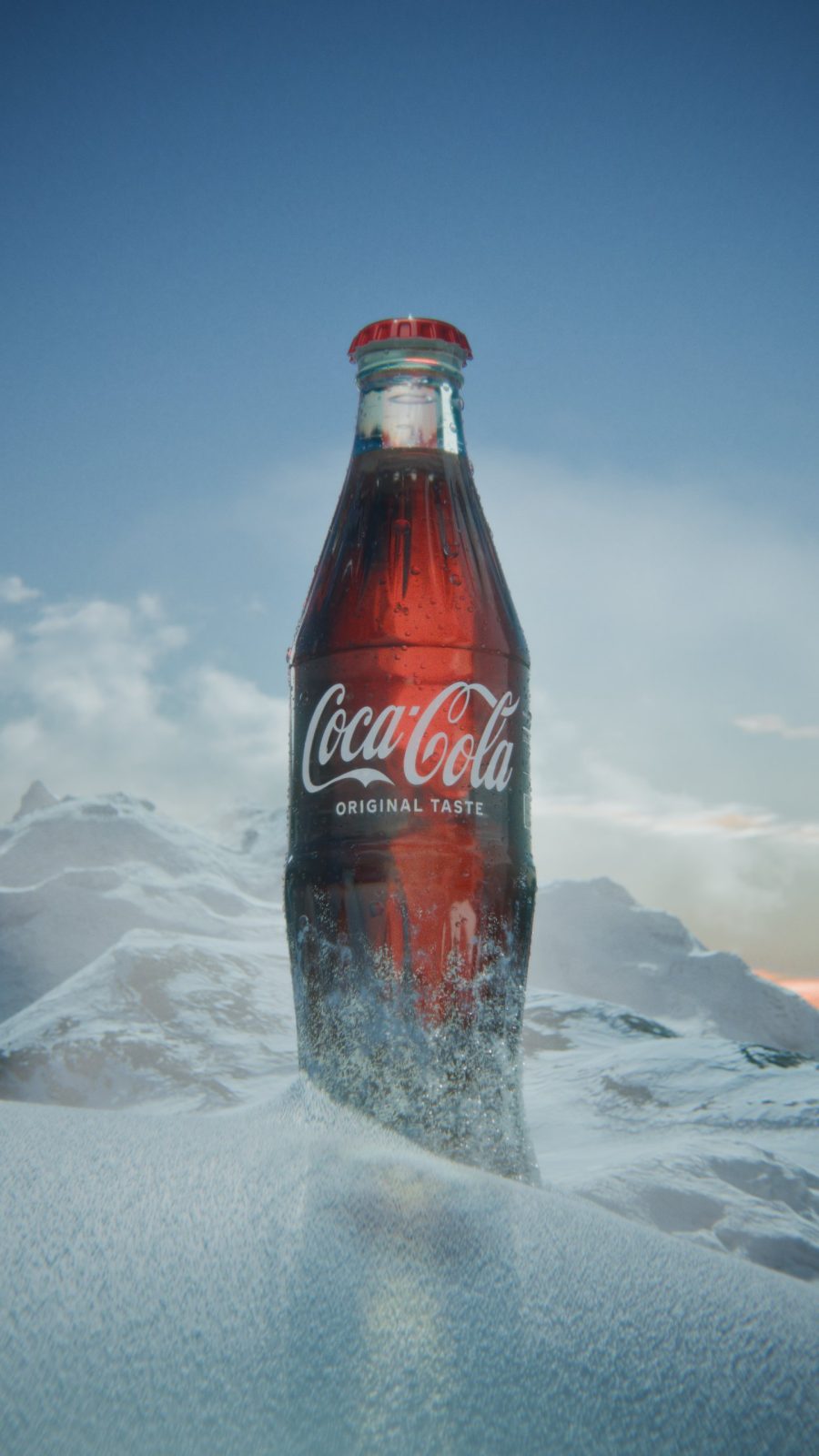
Glass becomes visible through what it does to light. Its edges, thickness, reflections and distortions describe the form; condensation and frost add another layer of scale, temperature and texture. In CGI, each of those signals has to work together.
Why is glass difficult to render?
An opaque object carries its appearance on its surface. Glass borrows much of its appearance from the world around and behind it. A clear bottle against a blank bright background can almost disappear; the same bottle in a busy environment can collect so many reflections and distortions that its design becomes hard to read.
The task is to give the eye enough information. Edge highlights describe thickness. Dark and bright shapes reveal curvature. Refraction bends the background. Small surface changes stop the object feeling mathematically perfect.
Geometry comes before the material
A convincing glass shader cannot correct an impossible object. Bottles and glassware need sensible wall thickness, shaped rims, bases and transitions. Corners that are perfectly sharp often fail to catch the highlights that make a manufactured object legible.
If the vessel contains liquid, the boundaries between glass, air and liquid need care. Overlapping or incorrectly separated surfaces can create odd dark lines and unrealistic distortion. The exact setup depends on the form and how close the camera gets.
How should refraction and reflection be balanced?
Refraction shows the light bending through the material; reflection shows the world on its surface. Both are physically connected, but their visible balance is shaped by camera, environment and lighting.
For a product image, physical plausibility is the starting point rather than the only goal. Reflections may be composed to reveal a shoulder or label. Background elements may be simplified so the silhouette reads. Art direction decides which true behaviours help the product and which merely make the frame busier.
What makes condensation look natural?
Real condensation has hierarchy. Some areas remain relatively clear, some collect fine mist, and others develop larger droplets that merge or run. Uniform dots across the whole object usually look procedural in the wrong way.
Scale is equally important. Droplets that are too large make a bottle feel miniature; droplets that are too fine may disappear at delivery size. Camera distance and final resolution should guide how much detail is built. The Chilled Cola study explores condensation and frost as central parts of the image.
Frost should change the surface, not simply cover it
Frost affects roughness, transparency and the way light scatters. It tends to gather unevenly, respond to contact and reveal transitions between colder and warmer regions. A convincing build-up needs a readable shape at a distance and enough fine detail to hold up close.
For motion, the way frost develops may matter as much as its final appearance. A procedural or simulated approach can help when the audience sees that change. For a still, a more directly art-directed method may offer better control. The visible result should choose the technique.
How do you light transparent products?
Light the reflections and the background as much as the object. Large sources create clean shapes along the glass. Dark cards or dark parts of the environment can define an edge. Coloured backgrounds pass through the object and become part of the product palette.
Labels and liquid colour need their own attention. A beautiful transparent form is not successful if the brand face becomes unreadable. KUBIK’s Glass & Bottles studies and Garasu series explore glassware, colour and controlled lighting through different visual treatments.
When is CGI useful for drinks and packaging imagery?
CGI is useful when the campaign needs repeatable variants, precise control of condensation, a product that is not ready to shoot or an environment that would be difficult to build physically. It can also move between clean product views and more atmospheric settings while keeping the core geometry consistent.
Photography may still be the better route when spontaneous physical behaviour is the idea or when a real pour, splash or interaction will be faster and richer on set. The decision belongs to the shot. Our guide to CGI vs product photography covers that choice in more detail.
From the KUBIK portfolio
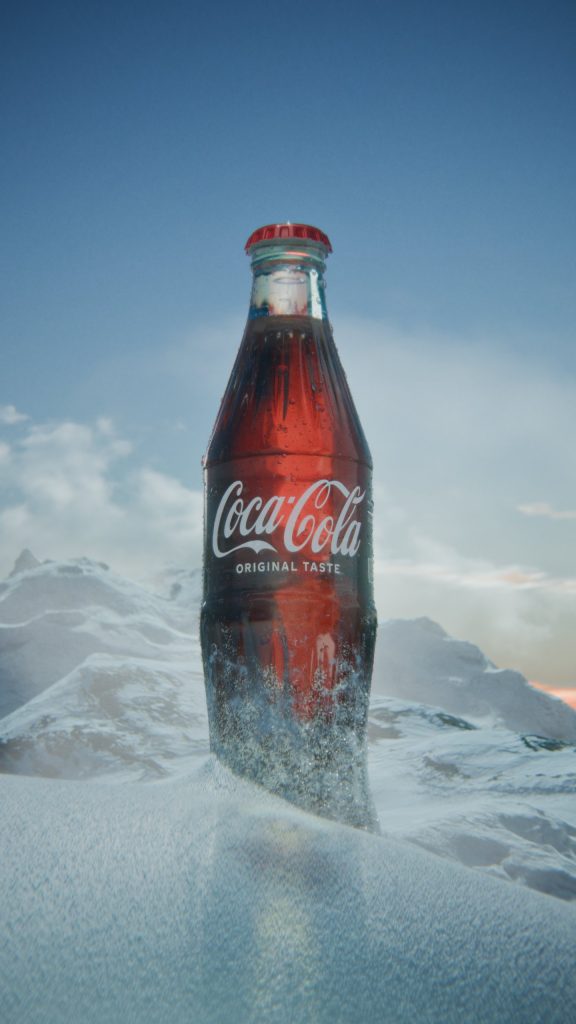
The image above is a finished portfolio example. It illustrates the visual subject discussed here; it is not a software screenshot or a claim that every technique in this guide was used on this particular frame.
Glass and condensation CGI FAQs
Does every droplet have to be simulated?
No. Droplets can be placed, generated or simulated depending on whether they move, how close the camera gets and how much direct control the shot needs.
Can one bottle be rendered in several colours?
Yes, if the glass, liquid, label and lighting changes are planned as a set of variants. Each version should still be reviewed because transparency can shift the balance of the whole frame.
Why does transparent CGI sometimes look too dark?
Incorrect geometry, overlapping surfaces, excessive depth, the environment and render settings can all contribute. The studio needs to check the complete light path rather than simply brighten the material.
Need a product to feel cold, clear or tactile? Show KUBIK the product and intended frame.